
More than a crude percentage
Moisture changes how raw-food percentages look. Nutrient density and essential amino acids must be assessed in relation to energy.
Science · 02
INU starts with the dog as an animal adapted to animal-rich food, then tests the whole formula against modern nutritional, analytical and safety standards.
Biology plus verification
Moisture changes how raw-food percentages look. Nutrient density and essential amino acids must be assessed in relation to energy.
Calcium, phosphorus and their ratio require deliberate control. Bone inclusion alone does not demonstrate balance.
Fatty-acid sources, vitamin correction, oxidation control and storage conditions must be considered together.
Supplier review, traceability, hygiene, microbiological criteria and frozen-chain validation form part of the product standard.
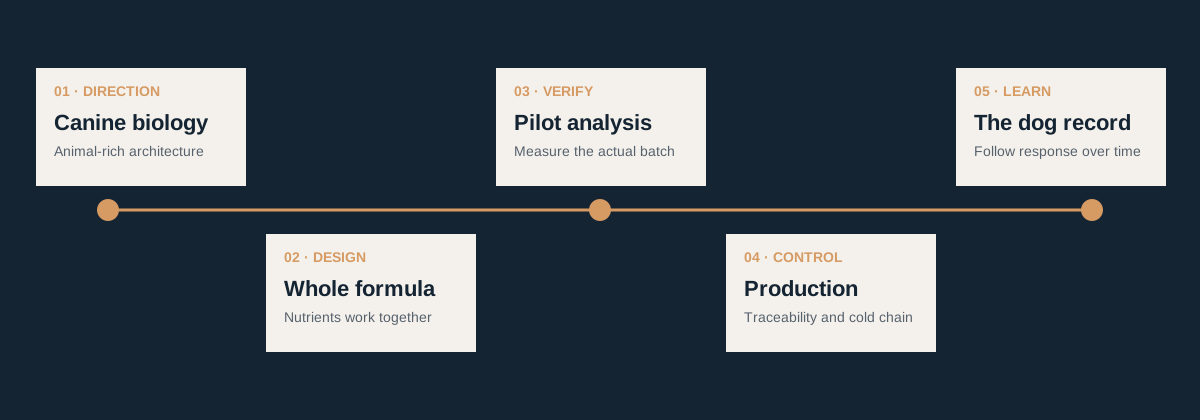
The INU standard: Every launch recipe earns its place through whole-recipe formulation, pilot-batch analysis, manufacturing validation and qualified sign-off.
The evolutionary position
Dogs can digest starch. INU chooses animal-rich nutrition as the centre of the formula.
Evolutionary biology sets the direction. Modern formulation controls energy, essential nutrients, minerals and safety. Neither principle is strong enough on its own.
Read the domestication research ↗Published and reviewed
Why INU goes further
INU does not ask owners to trust a trend. We define the recipe, verify the nutritional architecture, control production and keep the dog’s response connected to the plan.
That is how evolutionary nutrition becomes a modern, accountable product rather than a belief system.
Standards and references
These references guide formulation, nutrition assessment and the boundary between general feeding support and veterinary care. Product-level evidence will be added as validation is completed.
Founding 100